
Fort Stockton Release Paths
TDCJ can record several outcomes after a person leaves Fort Stockton Unit. Parole permits release from confinement under TDCJ Parole Division supervision. Mandatory supervision is another supervised form of release governed by sentence and offense-date rules. Discharge ordinarily means the sentence obligation has ended. None of those terms means the same thing as transfer.
Fort Stockton Unit is classified for G1, G2, and transient custody. “Transient” is especially important because people may pass through the unit as part of a move within TDCJ. A person missing from this facility can remain imprisoned elsewhere. Search the statewide system before drawing a conclusion from a unit change. For a completed release, look for an actual past release/status entry, then confirm Parole Division supervision or final discharge when that distinction matters.
Search Fort Stockton TDCJ Records
Use the TDCJ Inmate Information Search. Search by last and first name, or use the TDCJ or State Identification number for a stronger match. Compare name, identifiers, offense information, and location. A projected release date is an estimate. A scheduled release date and location indicate more advanced processing, but TDCJ warns that even scheduled information can change without notice.
- Record the result’s status and its “as of” time.
- Check whether the location changed to another TDCJ unit.
- Separate projected or scheduled dates from an actual release event.
- For parole review, use Board records and the status line.
- After release, verify supervision with the Parole Division or final discharge with TDCJ records.
The Inmate Release Date guide explains these date fields. TDCJ search coverage does not include someone whose custody ended solely at Pecos County Jail.
Fort Stockton Unit Details
TDCJ identifies Fort Stockton Unit, code N5, as a Correctional Institutions Division prison for men. It is at 1536 IH-10 East, Fort Stockton, TX 79735, about one mile northeast of downtown. The unit telephone is 432-336-7676, extension notation 062. TDCJ lists a capacity of 606 and says the facility was established in July 1992.
The official directory lists CHANGES/Pre-Release and Reentry Planning. Those entries support contacting the unit or TDCJ Reentry and Integration channels about program navigation. They do not support a promise of release, transportation, property pickup, identification documents, or a specific community service. Call before relying on local logistics. A program entry and a favorable parole decision are not proof that the person has passed through release processing.
Fort Stockton Release Records
For general inmate information, TDCJ lists 936-295-6371 and 800-535-0283 on weekdays from 8 a.m. to 5 p.m. A quick written request may be sent to pia@tdcj.texas.gov with the full name and seven-digit TDCJ number, or exact birth date or approximate age and county of conviction. TDCJ says this route can return location, offense, incarceration history, and projected release information without charge, but it does not provide photographs.
Formal requests go through the TDCJ public-information channel, PIA@tdcj.texas.gov, or TDCJ Public Information Request, P.O. Box 4017, Huntsville, TX 77342. Ask for actual release date and type, incarceration history, parole, mandatory-supervision or discharge status, and any departmental identification photograph sought. Classification and Records lists 936-437-6231 and classify@tdcj.texas.gov for time and release-record functions.
Fort Stockton Parole Evidence
The Texas Board of Pardons and Paroles makes parole and discretionary mandatory-supervision decisions. Eligibility or a favorable vote does not itself prove release. Program completion, certificate review, release-plan approval, warrants, detainers, and scheduling may remain. The Board status line, 844-512-0461 on weekdays from 8 a.m. to 5 p.m. Central, can provide review status, the last decision and date, and the next review when identifiers are supplied.
After a favorable decision, the TDCJ Parole Division release-status line at 512-406-5202 can address processing with a TDCJ or SID number or birth date. Once released, Pecos County maps to the Monahans District Parole Office at 401 S. Allen Avenue, Monahans, 432-943-7254. Actual assignment can follow approved residence or a special caseload, so call first. Never publish a person’s private reporting instructions.
ICE Holds at Fort Stockton
An immigration detainer can affect state release processing, but the detainer itself does not prove ICE took custody. Confirm TDCJ’s scheduled or actual release location and the recorded transfer outcome. If TDCJ documents an immigration handoff, use the ICE detainee locator and the proper ICE contact.
A missing ICE result is not proof of community release. Transfers, recent intake, protected cases, and name variations can limit the locator. Keep each fact tied to its source: TDCJ establishes departure from state custody or a transfer destination, while ICE establishes searchable immigration custody. The same caution applies to a federal hold. A BOP record is relevant only to federal Bureau of Prisons custody and does not replace the TDCJ release record.
Pecos Facilities Are Different
Fort Stockton Unit is one of two TDCJ prisons in Pecos County. James Lynaugh Unit is the other. Pecos County Jail, operated by the sheriff, handles local county custody and has a different records path. The Old Pecos County Jail is a museum built in 1883 and enlarged in 1913. The juvenile probation office is not established as a public detention center. Similar location words should never merge these five records systems.
Start with the operator. TDCJ records control a Fort Stockton Unit inquiry. Sheriff records control a county-jail inquiry. Juvenile matters follow restricted juvenile process, and the museum has no current inmates. The Pecos County release search provides the cross-system route when the last custodian is uncertain.
Avoid City of Pecos Results
Pecos County’s seat is Fort Stockton. The City of Pecos and its municipal criminal justice center are in Reeves County. A web result containing “Pecos” may therefore point to the wrong county and an unrelated custodian. Fort Stockton Unit’s official TDCJ code, N5, and its Fort Stockton address help resolve the ambiguity.
Do not use the City of Pecos corrections page or a Reeves County jail entry to explain a Fort Stockton Unit departure unless a named TDCJ transfer record sends the person there. Match the person’s TDCJ number, agency, unit code, and status. Geography alone is weak evidence.
Fort Stockton Notifications
TDCJ IVSS provides supported state-prison event notifications and is separate from IVSS-Counties, the participating county-jail portal. Find the correct person with strong identifiers before following a record. Alerts can lag, duplicate, or be corrected, so compare each notice with current TDCJ information and the actual release entry.
A notification does not calculate a sentence, certify discharge, or prove that no other hold remains. TDCJ Victim Services lists 800-848-4284 and victim.svc@tdcj.texas.gov for state-system help. Save the event wording and update time, then use the formal records channels when official confirmation is needed.
Fort Stockton Unit Image
The official TDCJ Fort Stockton Unit directory shows the facility classification, contact information, custody levels, and listed programs.
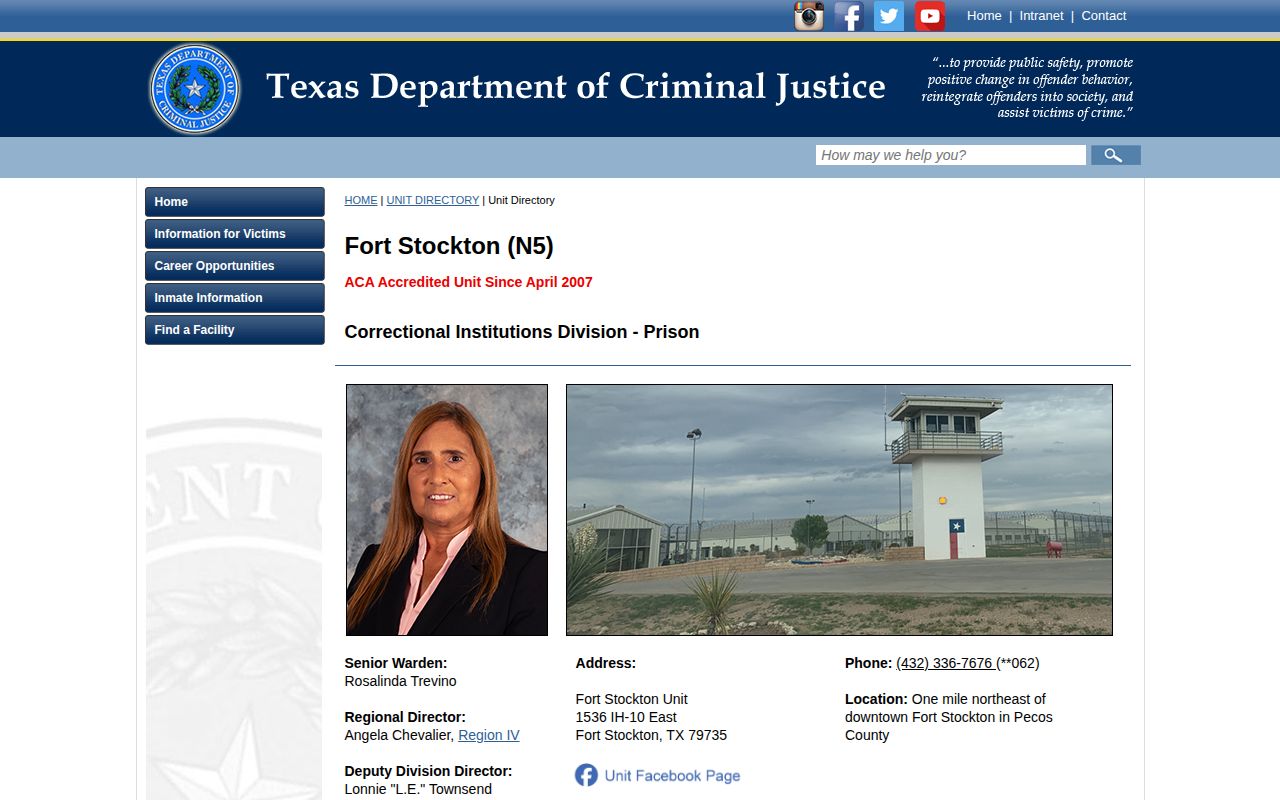
Use that directory to confirm the facility identity, then use statewide offender information for a person’s current or former status. A static unit page does not prove an individual release.
Fort Stockton Date Confirmation
TDCJ Classification and Records calculates a projected release date from the controlling sentence and offense rules. A scheduled release date and scheduled location may appear later when release processing advances. Both are prospective. TDCJ warns that even a scheduled date may change without notice. Only the later past release event confirms that the person actually left state custody.
Fort Stockton Unit houses transient prisoners, which makes a missing unit assignment especially weak release evidence. Search the statewide TDCJ record again and ask whether the person moved to James Lynaugh Unit, another TDCJ facility, parole processing, or an outside custodian. Keep the TDCJ number and the date of each status check.
Texas has no universal 85-percent prison rule. Good conduct and parole eligibility depend on Government Code Chapters 498 and 508, the offense, offense date, judgment, and credit record. Eligibility permits Board review but does not order release. A favorable Board vote can still require certificate review, program completion, plan approval, detainer clearance, and scheduling.
After actual release, distinguish parole or mandatory supervision from final discharge. Pecos County maps to the Monahans District Parole Office as a routing point, but approved residence or a specialized caseload can change the assignment. Confirm the actual office before giving reporting directions.
The unit directories list CHANGES/Pre-Release and Reentry Planning. Contact the correct unit or TDCJ reentry channel for program information, but do not infer a release promise, transportation plan, property process, or service that the official listing does not state.
Public Record Search
Sponsored Results