
Pecos Parole and Probation
Parole and probation both allow a person to live outside a jail or prison while following court or agency rules, but they arise from different decisions. Parole follows a state prison sentence. The Texas Board of Pardons and Paroles makes the release decision, and the TDCJ Parole Division manages supervision. Probation, called community supervision in Texas law, is imposed by a trial court instead of, or after a shorter part of, confinement. The Permian Basin Community Supervision and Corrections Department handles adult probation cases in Pecos County.
The releasing agency matters. A person who left Pecos County Jail on a court order may report to the local CSCD. A person released from Fort Stockton Unit or James Lynaugh Unit on parole or mandatory supervision follows TDCJ instructions. Mandatory supervision is a form of supervised state-prison release based on sentence rules and, for many cases, Board review. Neither status should be guessed from the place of arrest.
| Question | Parole | Probation |
|---|---|---|
| Who orders it? | Texas Board of Pardons and Paroles | The sentencing court |
| Who supervises it? | TDCJ Parole Division | Permian Basin CSCD |
| What came first? | A TDCJ prison sentence | A court judgment placing the person on community supervision |
| Best confirmation | TDCJ status, Board information, and assigned parole office | Court cause and the local CSCD |
- Parole
- Conditional release from state prison before the sentence fully expires.
- Probation
- Court-ordered community supervision, often used instead of jail or prison confinement.
- Discharge
- The formal end of a sentence or supervision term.
- Absconder
- A person alleged to have stopped reporting or left supervision without permission.
Verify Pecos Post-Release Supervision
Start with the record that created the supervision. The TDCJ Inmate Information Search can identify a state prisoner or selected former prisoner and may show release-related fields. The Board offender-information page explains the parole status routes. For probation, use the cause number and signed judgment from the Pecos County court, then confirm administration with the Pecos County Adult Probation Department.
- Identify the last custodian. Separate Pecos County Jail from a TDCJ unit and from federal or immigration custody.
- Match the full name with a TDCJ, SID, booking, or court cause number when available. Similar names are not enough.
- For parole, review the TDCJ record and call the Board status line at 844-512-0461 for review or decision information.
- For probation, obtain the court judgment and contact the Permian Basin CSCD office serving Pecos County.
- Ask which office is assigned before giving anyone reporting directions. Residence and specialized caseloads can change the office.
- Record the source and its update date. A release date and a supervision status answer different questions.
A person may be physically out of prison yet still serving a sentence on parole. Another may have completed custody and probation but lack a simple online status page. The Pecos County released-inmate search and records overview explains how to pair the jail release event with court and state records.
Pecos Supervision Office Routes
Pecos County has two different post-release office routes. The local probation office is in Fort Stockton. TDCJ's county cross-reference maps Pecos County parole supervision to the Monahans District Parole Office in Region V. That map is a starting point, not proof of a particular assignment. An approved home address or specialized caseload may place a person elsewhere.
Permian Basin CSCD
111 W. Gallagher
P.O. Box 1706
Fort Stockton, TX 79735
432-336-8562
Fax: 432-336-2932
No public reporting hours were found. The person under supervision must follow the court order and officer's directions.
Monahans District Parole Office
401 S. Allen Ave.
Monahans, TX 79756
432-943-7254
Fax: 432-943-7397
Call first to confirm the assigned office. Do not publish or infer an individual's reporting schedule.
The TDCJ county cross-reference and Region V directory are the official routing sources. They should be checked again if the person's approved residence changes.
Pecos Supervision Violations and Warrants
Conditions are the rules attached to release. They can include reporting, approved residence, program participation, payment duties, travel limits, or conduct set by the court or parole authority. The precise order controls. A general agency page cannot establish one person's terms. A violation allegation also does not, by itself, prove that supervision has been revoked.
No official Pecos County probation absconder list or sheriff warrant list was verified. For a named probation warrant, contact the issuing court, sheriff, or CSCD as appropriate. A parole warrant belongs with TDCJ Parole Division or the Board process. Public details may be limited when release could interfere with enforcement.
Texas IVSS can supply custody or event notifications when the correct agency participates, but an alert is not a warrant record or court ruling. Use the current Texas IVSS portal, keep the event time, and verify a change with the agency that supplied it. Silence in the portal is not proof that supervision ended.
How Pecos Supervision Ends
Supervision ends through a formal record, not merely because a person stops appearing in custody search results. For probation, look for the court order or docket entry showing completion, early termination, revocation, or another disposition. For parole or mandatory supervision, obtain TDCJ status and the final discharge record. Physical release from a unit begins the community phase; it does not necessarily end the sentence.
The Texas Public Information Act in Government Code Chapter 552 applies to existing executive-branch records subject to exceptions. Court files follow judicial access rules instead. A clear request names the person, identifying number, desired discharge or supervision record, and date range. Confidential parole-file components and protected personal data can still be withheld.
Pecos Parole Reentry Programs
Both TDCJ prisons in Pecos County identify pre-release programming. The Fort Stockton Unit directory and James Lynaugh Unit directory list CHANGES/Pre-Release and Reentry Planning. Those listings support a direct program-navigation route through the correct unit and TDCJ. They do not promise release, transport, identification documents, or a specific community service.
A family member should first confirm the person and unit through TDCJ, then ask the unit or TDCJ reentry channel what program information can be shared. Fort Stockton Unit houses transient prisoners, so a move from that unit may be a transfer rather than release. James Lynaugh Unit also uses the statewide TDCJ release and supervision path.
The distinction is practical. Program completion can be one step in release planning, while certificate review, residence approval, detainers, and scheduling may remain. Only a past release event confirms that the person left TDCJ custody. Keep the date when the status was checked.
Pecos Parole Division Source
The official TDCJ Parole Division page identifies the state agency responsible for supervising people released on parole and mandatory supervision.
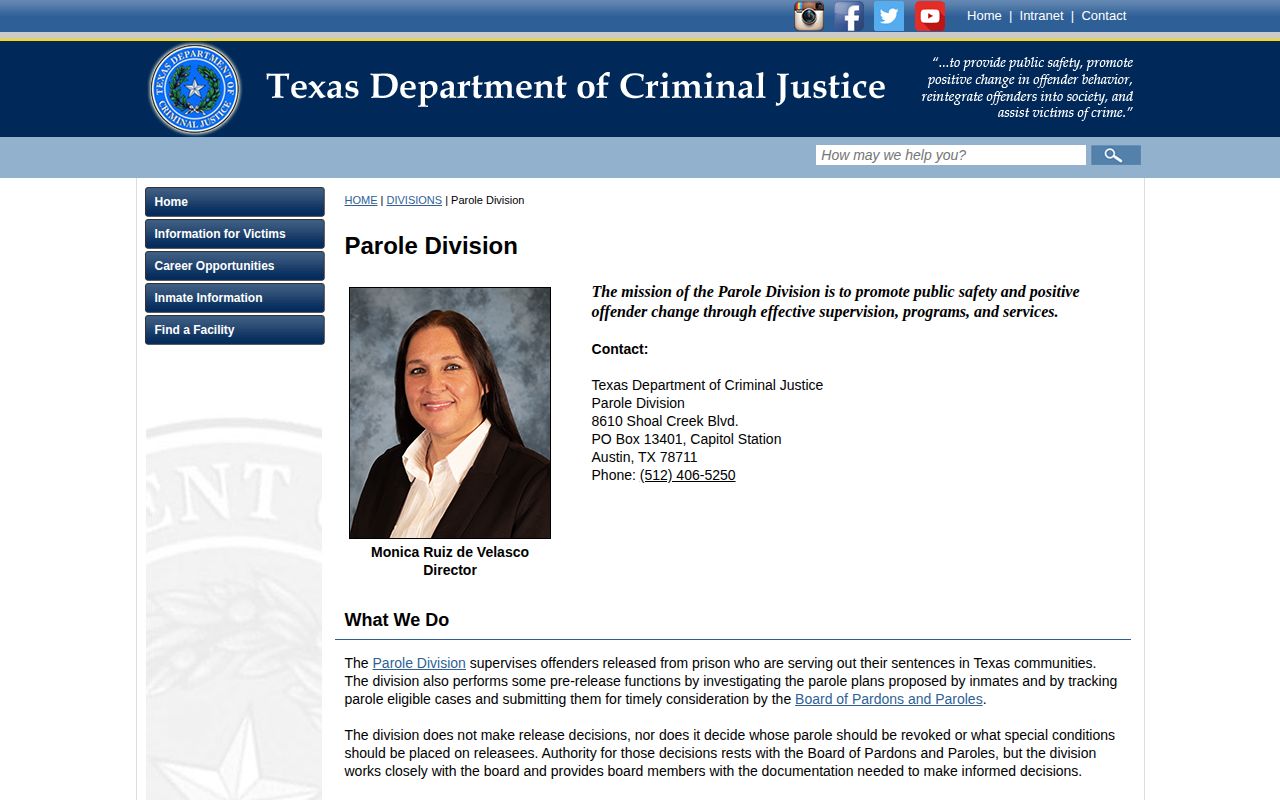
Use that agency source with the Board decision record and the assigned district office. None of the three should be replaced by a county jail roster.
Pecos Parole Decision Records
The Texas Board of Pardons and Paroles makes parole and discretionary mandatory-supervision decisions. Routine initial matters are commonly decided through panel file review, not a public courtroom hearing. No official person-by-person calendar of routine vote dates was verified. State open-meeting agendas should not be relabeled as an inmate parole calendar.
For a named case, combine the TDCJ offender detail with the Board status line at 844-512-0461, weekdays from 8 a.m. to 5 p.m. Central. The current Board guidance says the line can provide whether review is underway, the last decision and date, and the next review. Those facts describe a decision process. They do not confirm that the person passed through the release gate.
A favorable vote may still depend on a program, certificate audit, release plan, detainer review, or scheduling. The TDCJ Parole Division release-status line at 512-406-5202 is the next route after a favorable decision. Have the TDCJ or SID number, or the date of birth. Confirm actual departure through the later TDCJ release event, then use the assigned office to verify community supervision.
Revocation is separate. It addresses an alleged violation after release and may lead to a hearing through TDCJ Hearing Operations. A warrant or return to custody does not erase the original release record. Keep the initial release date, the alleged violation record, the Board outcome, and any new custody event as distinct entries.
Texas DPS also operates a public sex-offender registry, but it applies only to people with a registration duty. It is not a parole or probation list. Presence there does not explain the release type, and absence does not prove that supervision ended. Use it only when that distinct statutory record is relevant.
Board eligibility is also distinct from release. Government Code Section 508.145 uses offense and offense-date rules, while Section 508.149 addresses mandatory-supervision exclusions and decisions. A first eligibility date only permits review. It is not a promise that the Board will finish review or that TDCJ will release the person on that date. Preserve the Board decision code and its date, then verify each later processing step.