
James Lynaugh Release Outcomes
A person can leave James Lynaugh Unit without leaving TDCJ custody. Unit transfer is common within a statewide prison system, so the absence of the old unit name is weak evidence. Search by TDCJ or State Identification number when possible and inspect the current location and status. A move to another unit is continued confinement.
Parole and mandatory supervision allow a person to live outside prison under TDCJ Parole Division supervision. They are not final discharge. Discharge ordinarily marks the end of the sentence obligation. A projected date predicts a possible future departure, while an actual past release event shows completed processing. The useful confirmation chain is statewide result, actual release type, supervision evidence if applicable, and final discharge record when supervision ends.
Search James Lynaugh Records
Open the official TDCJ Inmate Information Search. Enter a last and first name, TDCJ number, or SID number. Compare the identifiers, offense information, status, and location. Do not use a Pecos County jail result for this prison population.
- Save the exact result wording and update date.
- Check whether LH changed to another unit code.
- Treat projected and scheduled dates as prospective.
- Look for an actual release or discharged status.
- Confirm parole or mandatory supervision through the Parole Division.
A scheduled release date and scheduled release location are more concrete than a projection but can still change, even on the stated date. The Inmate Release Date page gives more context on TDCJ calculations. Texas has no general 85-percent rule; offense date, judgment, eligibility law, credits, Board action, and holds can all matter.
James Lynaugh Unit Facts
James Lynaugh Unit, code LH, is a TDCJ Correctional Institutions Division prison for men. Its official address is 1098 South Highway 2037, Fort Stockton, TX 79735, about 15 miles southwest of downtown. The telephone number is 432-395-2938. TDCJ lists a capacity of 1,416 and G1, G2, and G4 custody levels.
The unit directory lists CHANGES/Pre-Release and Reentry Planning. Those are valid points of contact for program navigation, but they do not guarantee release or document a completed departure. No researched source establishes a standard gate time, family waiting location, transportation arrangement, property process, or local service package. Contact the unit for current instructions rather than relying on assumptions drawn from another prison.
James Lynaugh Release Requests
TDCJ general inmate information is available at 936-295-6371 or 800-535-0283 on weekdays from 8 a.m. to 5 p.m. For a quick written inquiry, email pia@tdcj.texas.gov with the full name and seven-digit TDCJ number. Without that number, include the exact birth date or approximate age and county of conviction. The response can include location, offense, incarceration history, and projected release information, but not a photograph.
Formal requests may use the TDCJ public-information portal, PIA@tdcj.texas.gov, or TDCJ Public Information Request, P.O. Box 4017, Huntsville, TX 77342. Ask for existing records that show actual release date and type, incarceration history, parole, mandatory-supervision or discharge status, and a departmental identification photograph if needed. Classification and Records may be reached at 936-437-6231 or classify@tdcj.texas.gov for sentence and release-record functions.
James Lynaugh Parole Checks
The Texas Board of Pardons and Paroles makes parole and discretionary mandatory-supervision decisions. Routine review is often a file review, not a public courtroom hearing, and no reliable public person-by-person hearing calendar was verified. Call the Board status line at 844-512-0461, weekdays from 8 a.m. to 5 p.m. Central, with the required identifiers to ask about current review, the last decision and date, or next review.
A favorable vote is not the same as release. A program, certificate audit, release plan, detainer, warrant, or scheduling step may remain. After a favorable action, the Parole Division line at 512-406-5202 can address release processing. Pecos County maps to the Monahans District Parole Office, 401 S. Allen Avenue, Monahans, 432-943-7254, though approved residence and caseload can change the actual assignment.
ICE Holds After Lynaugh
An ICE detainer is a request, not proof of an immigration transfer. If a James Lynaugh release is expected, first confirm TDCJ’s recorded release location and actual outcome. When TDCJ identifies transfer to immigration authorities, check the ICE Online Detainee Locator and contact ICE if the result remains unclear.
No ICE match does not prove community release. Recent movement, protected information, spelling differences, or locator limits may explain silence. Keep the TDCJ and ICE records together because each answers a separate custody question. If the state record identifies another TDCJ unit, there was no immigration handoff and no community release from state custody.
Pecos County Custody Divide
James Lynaugh and Fort Stockton are the two TDCJ prisons in Pecos County. The Pecos County Jail is a sheriff facility for local custody. Its booking and release record cannot establish a state-prison discharge. The Old Pecos County Jail, built in 1883 and enlarged in 1913, is now a museum. Pecos County Juvenile Probation is a youth agency, not a proven public detention center.
This mix makes operator and facility code more useful than the phrase “in Pecos County.” For LH, use TDCJ. For the county jail, use the sheriff and court. For juvenile matters, follow confidential juvenile process. The Pecos County released inmate search helps identify the right branch when the facility is uncertain.
Reject Reeves County Matches
The City of Pecos lies in Reeves County. Its municipal criminal justice center is not in Pecos County and has no routine role in James Lynaugh Unit records. Pecos County’s seat is Fort Stockton. A search engine may blur the city and county names, so verify “TDCJ,” unit code “LH,” and the Fort Stockton address.
Use a Reeves County or City of Pecos record only if a documented transfer points there. Never treat the similar place name as proof. Match the TDCJ number and agency before connecting records.
James Lynaugh Notifications
TDCJ IVSS supports notifications for state-prison events and differs from IVSS-Counties, the participating county-jail portal. Match the correct person with a TDCJ number or other strong identifiers before following the record. An alert can lag, duplicate, or change, so compare its wording and time with statewide TDCJ information.
TDCJ Victim Services lists 800-848-4284 and victim.svc@tdcj.texas.gov for state-system help. A notification does not calculate the sentence, certify discharge, or rule out another hold. Use Classification and Records or the formal information channel when an official release record is required.
View James Lynaugh Details
The official TDCJ James Lynaugh Unit directory documents its address, classification, custody levels, capacity, and programs.
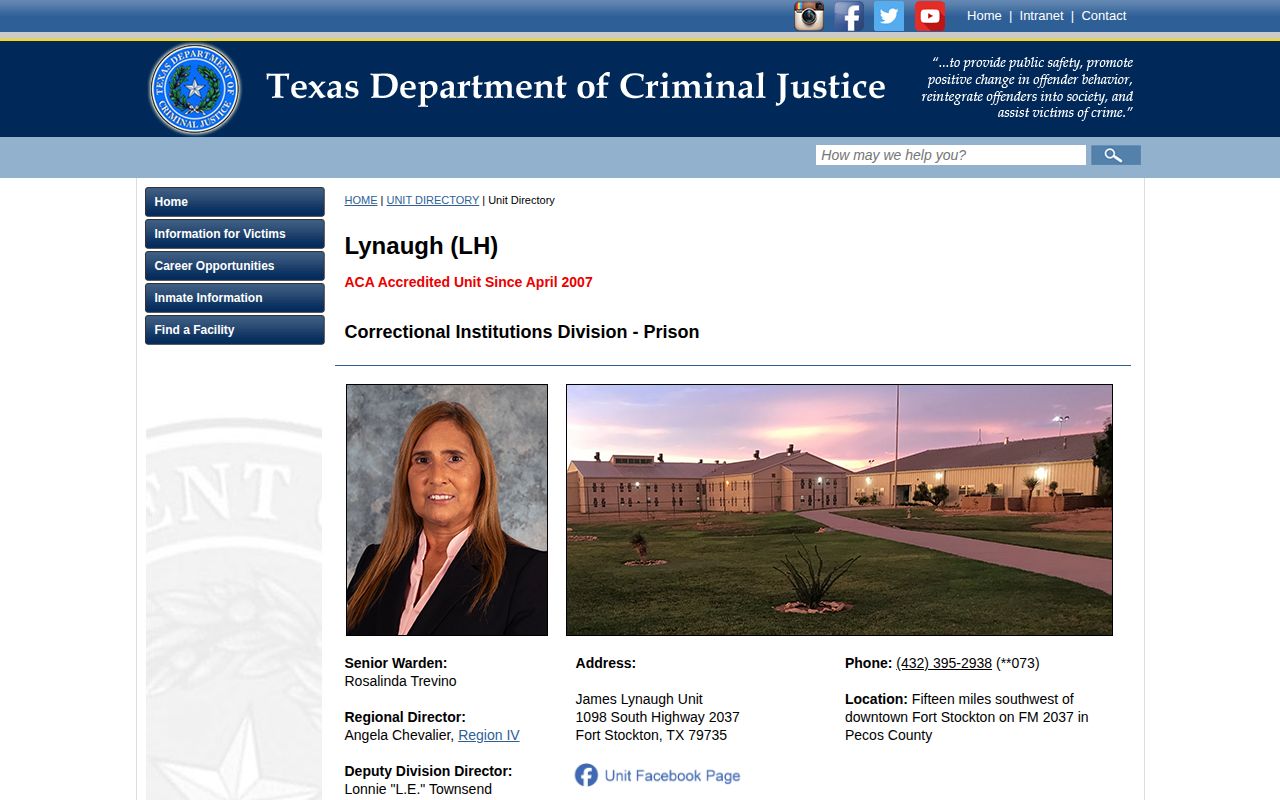
The directory confirms which institution is involved. Use the statewide person search and TDCJ records, rather than the static unit listing, to determine an individual outcome.
James Lynaugh Release Dates
A projected TDCJ date is an estimate calculated by Classification and Records. Offense title, offense date, sentence structure, good-conduct status, parole decisions, and other legal records can affect it. A scheduled date and location may appear after release planning advances, but TDCJ says those fields can still change without notice. Verify the actual past release event after the date passes.
Government Code Chapter 498 treats good-conduct time as a privilege, not an automatic subtraction from every sentence. Section 508.145 uses offense-specific and date-specific parole eligibility rules. Some cases use calendar time plus eligible credit, while specified serious cases require substantial calendar time without good-conduct credit toward the threshold. Texas does not have one general 85-percent rule.
A Board approval also does not always mean immediate departure from James Lynaugh Unit. A program vote, certificate audit, release plan, detainer, or scheduling step may remain. Use the Board status line for the decision record, then TDCJ release processing and the offender detail for later events.
Once the person leaves, determine whether the result is parole, mandatory supervision, transfer, or final discharge. Parole Division supervision can continue after physical custody ends. A final discharge record marks a different endpoint and should not be inferred from the release date alone.
James Lynaugh Unit lists CHANGES/Pre-Release and Reentry Planning. Those programs support direct navigation to the unit or TDCJ reentry staff, but they do not prove that a named prisoner completed a program or received approval. Do not promise transport, identification, benefits, or a set gate time. Confirm each release-planning fact through the person-specific TDCJ record.
For a formal record, request incarceration history, actual release date and type, parole or mandatory-supervision status, and final discharge status from TDCJ. The quick inmate-information route can supply selected fields but does not furnish departmental identification photographs. Use the formal public-information channel when the full release sequence or photo is needed.
Public Record Search
Sponsored Results