
Two Texas IVSS Routes for Pecos County
Texas changed its county notification service on September 1, 2025. The current county-jail route is IVSS-Counties, which the Texas Attorney General described as replacing VINE. Existing registrations carried over, and former users were prompted to update passwords and preferences. A legacy VINELink tutorial should not be treated as the current Pecos County screen.
The separate TDCJ IVSS portal covers state-prison notification. This distinction is critical in Pecos County because the county contains the Pecos County Jail plus Fort Stockton Unit and James Lynaugh Unit, both operated by TDCJ. Location inside the same county does not make their records interchangeable.
IVSS-Counties
Use for participating county-jail custody, including a local Pecos County booking when the agency and record appear in the live portal.
TDCJ IVSS
Use for a person in the Texas state-prison system, including someone held at or transferred from either local TDCJ unit.
Official confirmation
Use the Pecos County Sheriff or TDCJ record for the legal and operational release details behind an alert.
Search One Pecos County IVSS Record
Start from the last known custodian, not from the similarity of place names. The active county jail is in Fort Stockton. The City of Pecos and its municipal justice center are in Reeves County, while the Old Pecos County Jail is now a museum. Those search results do not establish current Pecos County custody.
- Open IVSS-Counties for a county detainee or TDCJ IVSS for a state prisoner.
- Select the supported agency or search context shown by the current portal.
- Enter the strongest identifiers offered, such as full name with demographic details or a booking, TDCJ, or offender number.
- Compare agency, name, age or date information, and custody record before opening a match.
- Record the exact status or event wording, the source agency, and the displayed update time.
- If the result says released, transferred, or out of custody, contact the source agency for the event date, type, and destination.
When several results look similar, do not choose by name alone. Match the available identifier and custodian. If no record appears, verify spelling and identifiers, then contact the sheriff or TDCJ. Silence can reflect participation, transmission delay, a protected record, a spelling difference, or a transfer.
What Pecos County IVSS Can Show
The live portals control their displayed labels and available fields. Read the exact wording rather than converting it to a broader conclusion.
| Portal detail | How to use it |
|---|---|
| Custody agency | Identifies the system supplying the event and the office that should verify it. |
| Name and identifying detail | Supports identity matching and helps reject a same-name result. |
| Custody or status wording | Reports the source's current category; preserve the exact phrase. |
| Facility or location | May show the current supplying location, but a location change can be transfer rather than release. |
| Event and update time | Shows when an alert or status was recorded, not necessarily when a court acted. |
| Registration status | Lets an account holder confirm that notification preferences were saved for the correct person. |
For a TDCJ prisoner, do not confuse IVSS notification with projected release, parole eligibility, Board action, or discharge. The TDCJ offender detail may show prospective and historical information with different labels. A projected date can change, and a favorable parole action can precede actual release processing.
Register for Pecos County Release Alerts
Registration should follow the current screen because available contact methods and confirmation steps can change. Keep account and confirmation information private.
- Create an account or sign in to the correct county or state IVSS portal.
- Locate and open the fully matched person record.
- Select the follow, register, or notification action offered by that portal.
- Choose among the contact methods currently displayed, such as phone, text, or email.
- Complete account and contact verification exactly as prompted on the live screen.
- Review the available event preferences and save the registration.
- Confirm that the person and preferences appear in the account, then retain the confirmation.
Older VINE telephone instructions often required a four-digit PIN to confirm calls. Current IVSS-Counties use of that PIN was not verified after the transition. Do not invent a PIN or reuse one from an old tutorial. If the current portal displays a PIN step, follow that screen; otherwise complete the account or contact verification it actually provides.
For help with the state-prison system, TDCJ Victim Services can be reached at 800-848-4284 or victim.svc@tdcj.texas.gov. The contact supports state-system notification help, not a substitute calculation of a person's sentence.
Pecos County IVSS-Counties Screen
The matched IVSS-Counties source is the correct live starting point for participating county-jail notifications. Its current interface should control the search and registration instructions.
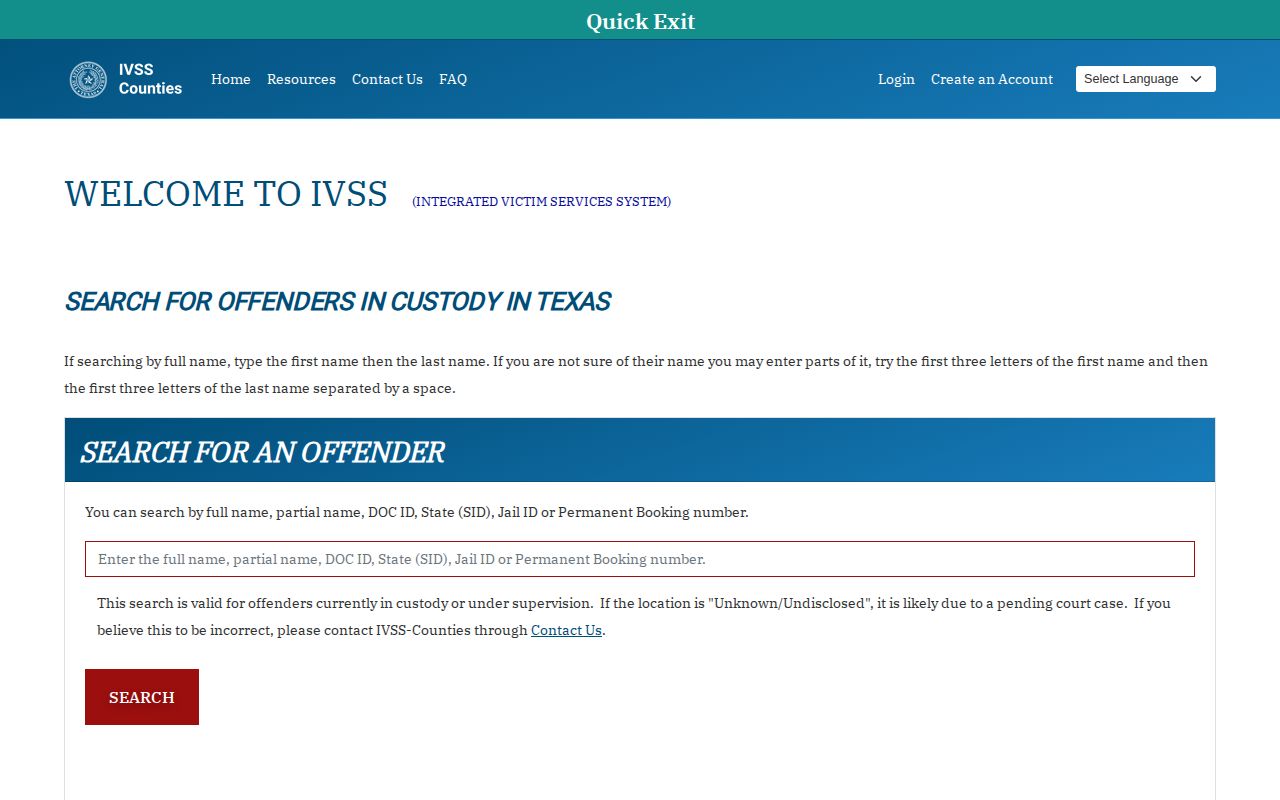
If Pecos County is not selectable or a known booking cannot be found, call the sheriff at 432-336-3521. The lack of a portal match should never be translated into a release, continued confinement, or absence of a booking.
Pecos County TDCJ IVSS Screen
The TDCJ IVSS portal is the notification route for state imprisonment. It is appropriate for a person at Fort Stockton Unit, James Lynaugh Unit, or another TDCJ unit after transfer.
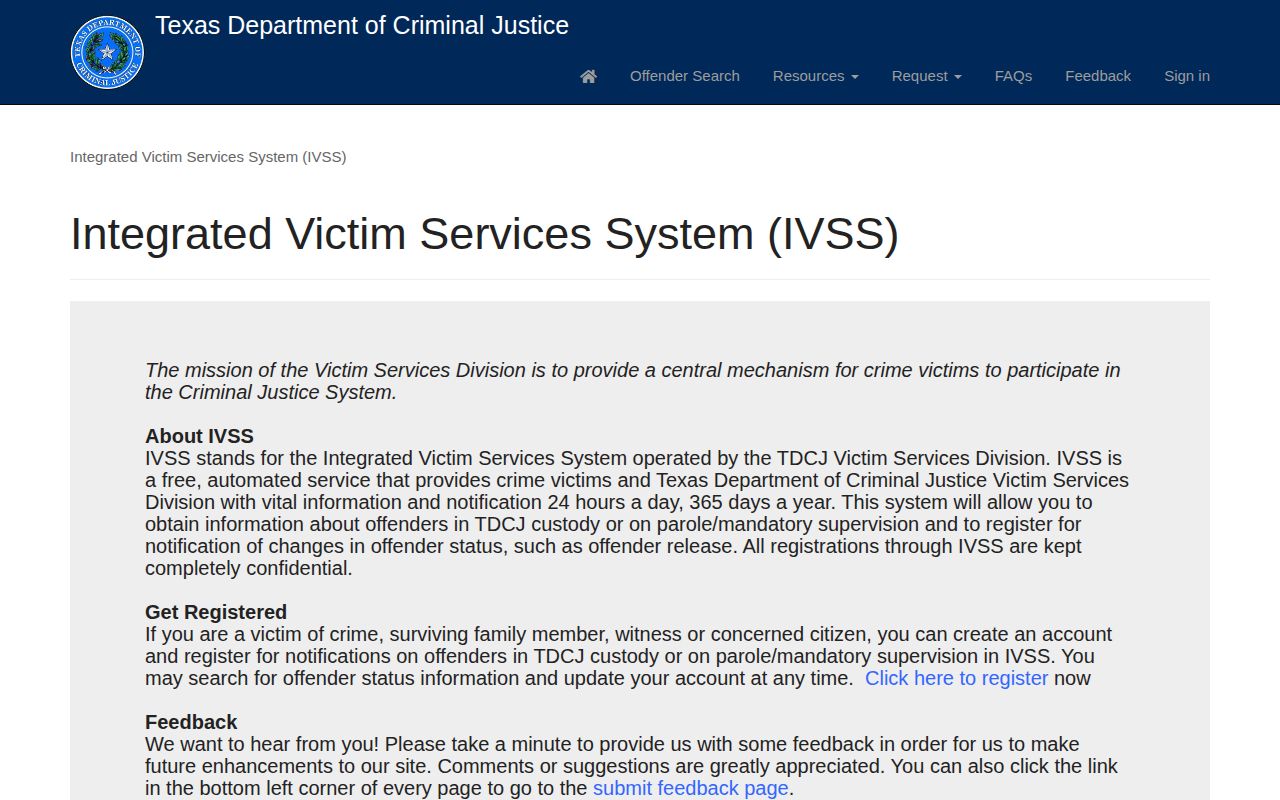
A person can disappear from one unit because TDCJ moved them to another. Search statewide through TDCJ Inmate Information and compare identifiers. Capture each relevant date with its displayed label, especially projected release, parole eligibility, scheduled release, actual release, or discharge.
Confirm a Pecos County IVSS Release
An IVSS event is a valuable alert, but the supplying government record provides the durable answer. For Pecos County Jail, call or request the sheriff's recorded release date, time, type, and destination. If departure was to another agency, follow the transfer rather than classifying it as community release.
Preserve the alert
Save the exact wording, agency, event time, update time, and matched identifier.
Ask the custodian
Request the source release or transfer record and destination rather than a general status opinion.
Check the legal record
Use the court cause for a local bond, dismissal, judgment, sentence, jail credit, or release-related order.
Follow continued custody
Search TDCJ, another jail, BOP, or ICE when the event identifies a receiving system.
The Pecos County release search and records guide connects those official paths for one named person. Notification should corroborate the custody chain, not replace it.
Limits of a Pecos County VINELink Check
Notifications can arrive late, repeat, or be corrected. Coverage can depend on agency participation and the data a source transmits. An alert also does not interpret a judgment, calculate sentence credit, resolve every detainer, or certify that no other custody exists.
Federal imprisonment is outside these Texas IVSS routes. The BOP Inmate Locator can retain a federal “Released” status and date for many people released since 1982, but it does not prove release from Pecos County Jail or freedom from all other custody. USMS lacks a comparable public historical locator. ICE ODLS searches current searchable immigration detention, and a no-result is not a release certificate.
The Texas DPS Sex Offender Registry is also separate. It applies only when law requires registration and is not a general list of former prisoners. Presence can show a public registration record, while absence says nothing conclusive about custody or release.
Note: Use the portal that matches the custodian, then use the custodian's own record to verify the event that triggered the alert.
Pecos County Released Versus Held Status
A current custody record answers where a person is held now. A past release record answers when and how that custody ended. Someone who bonded out of Pecos County Jail may no longer appear in current custody, yet remain documented in the sheriff's booking-out record and court cause. Someone transferred to TDCJ may vanish from the county source while remaining confined in the state system.
For a former TDCJ prisoner, save the displayed status and release date, then distinguish release to parole or mandatory supervision from final discharge. Physical release can coexist with active supervision. If an older person is missing from the public search, request TDCJ records using name, birth date, TDCJ or SID number, conviction county, and approximate confinement dates.
This careful wording keeps the VINELink-era search focused on its real purpose: notify a registered user about custody events for one matched person and provide a lead for prompt official verification.
Texas moved county notifications from legacy VINE to IVSS-Counties in 2025. Older instructions that require a four-digit telephone PIN should not be treated as the current Pecos County workflow unless the live screen asks for one. Create or sign into the correct account, select the matched person, choose the contact methods now offered, complete the displayed verification, and save the registration confirmation. Check that the registration appears in the account.
For state-system help, TDCJ Victim Services lists 800-848-4284 and victim.svc@tdcj.texas.gov. Contact the sheriff when Pecos County is not selectable or a named county booking is missing. Participation limits, spelling, protected status, transmission lag, and an inter-agency transfer can all cause an absent result. None of those possibilities should be converted into a release claim.
Keep alert contact details private. Notifications may be delayed, duplicated, or corrected, and available event types can depend on the supplying agency. A saved confirmation proves registration, not that every later event will arrive on time. For urgent custody questions, call the responsible agency and use IVSS as a second channel.
Recheck the live account after changing a phone number or email address.